
- Pick by data source first. Keyword Planner is Google's own ad data. Semrush and Ahrefs model volume from several sources, clickstream included. Mangools and Ubersuggest say they use Google data. AnswerThePublic is for questions and phrasing, not volume.
- Every volume is an estimate. Google rounds and averages its own figures, and Semrush, Ahrefs and Ubersuggest all describe theirs as estimates or models. Compare keywords inside one tool, not numbers across tools.
- Listed prices as of October 2026: Semrush's SEO plan $139 a month, Ahrefs Lite $129 (Starter $29), Moz Pro Standard $99, Ubersuggest a US$29 to US$99 range, AnswerThePublic from US$20. Mangools showed no amounts, so we quote none.
- Free options exist for every budget: Keyword Planner (with a Google Ads account), Semrush Free (10 reports a day), KWFinder (5 lookups per 24 hours) and MrKeyword (10 lookups a month).
- MrKeyword (our product) shows Keyword Planner figures through the official Google Ads API from $10 a month. It uses no clickstream; competitor keywords are predicted from its own page index, not measured.
Disclosure: MrKeyword publishes this page and is one of the eight tools compared. Every competitor fact links to the vendor's own page. We read them on 31 October 2026, except Moz, whose site we could not open that day; its figures are from Moz's pages as we read them on 29 October 2026. Where a vendor did not state a price or limit, we say so instead of quoting a third-party site.
What is the best keyword research tool?
There is no single best keyword research tool: the right one depends on where you want your numbers to come from and what else you need in the same login. Google Keyword Planner is the source closest to Google itself. Semrush and Ahrefs are the deepest databases, sold inside full SEO suites. Moz, Mangools and Ubersuggest are lighter, cheaper research tools. AnswerThePublic is for questions. MrKeyword gives you Keyword Planner figures without the ads account.
Most “best keyword research tool” lists rank tools by features. Features matter less than people think, because every tool here can suggest ideas, filter them and export a list. What actually differs is the data under the list: where the search volume comes from, how the difficulty score is built, and how much of it you can see before you pay. That is what this comparison is built around.
Where does keyword search volume come from?
Keyword tools get search volume in one of three ways: from Google's advertising data, from a model that blends third-party and clickstream data, or not at all, as with tools that list search suggestions. Knowing which one a tool uses explains most of the differences you will see.
- Google Ads data. Keyword Planner shows Google's own estimate of monthly searches. Google's help on Keyword Planner metrics says the figures are rounded, averaged over 12 months and include close variants of the keyword, so “car” and “cars” share one number. Tools that read the Google Ads API inherit the same figures.
- Modelled data. Semrush's knowledge base says it overlays data from third-party providers with historical clickstream data, then applies a machine-learning model to billions of keywords. Ahrefs' help center names Keyword Planner, Google Trends and other third-party sources in one article and clickstream processing in another. Clickstream data comes from panels of browser and app users, so a model can split close variants that Google merges, at the cost of being a model.
- Search suggestions. Tools built on the suggestions search engines show as you type surface real wording and questions, but suggestions alone carry no search count.
There is a fourth source, and it is the only one that is measured rather than estimated: Google Search Console. Its Performance report shows the impressions your own site earned for each query. It cannot size a topic you have never published on, but for queries where you already appear near the top it is the best check on any tool's number. Our guide on how to find keyword search volume shows how to use it alongside a tool.
How do the main keyword research tools compare?
Seen side by side, the tools split by data source and price far more than by features: two suites at well over $100 a month, three lighter tools, one question finder, Google's own planner and MrKeyword. The table sets out what each vendor's own page stated.
Keyword research tools compared, as of October 2026
| Tool | Where search volume comes from | Free option, as stated | Paid entry, as listed | Best fit |
|---|---|---|---|---|
| Google Keyword Planner | Google Ads data; ranges for low-spend accounts | Free inside Google Ads, billing details entered | No fee for the tool | Advertisers, and anyone who wants Google's own figure |
| Semrush Keyword Magic Tool | Third-party providers plus clickstream, modelled | Free plan, 10 reports a day across tools | $139/mo, SEO plan ($117.33/mo billed yearly) | Teams that want research, competitors and audits in one suite |
| Ahrefs Keywords Explorer | Keyword Planner, Google Trends, clickstream and other sources, modelled | Keyword Generator page; limits not stated | $129/mo, Lite; Starter $29/mo | Teams that want keyword data beside a large backlink index |
| Moz Keyword Explorer | Moz's own keyword index | Limited access with a free Moz Community account | $99/mo, Moz Pro Standard, 150 keyword queries; entry plan $49/mo (29 Oct) | Moz Pro users and teams that report Moz metrics |
| Mangools KWFinder | Google as a main source, post-processed | 5 lookups per 24 hours, 15 related keywords each | Not shown on the pages we read | Beginners who want a simple tool with difficulty and a results view |
| Ubersuggest | Several sources including Keyword Planner data | Free account; limits not stated; 7-day trial | US$29 to US$99/mo range shown | Solo site owners on a small budget |
| AnswerThePublic | Search phrasing from Google, Bing, Amazon, YouTube and others | Not stated on the pages we read | US$20/mo Starter (US$120 billed yearly) | Writers looking for the questions people ask |
| MrKeyword | Google Ads Keyword Planner, through the official API; no clickstream | 10 lookups a month, no card | $10/mo, Starter, 200 lookups | Site owners who want Google's figures beside their own Search Console data |
Is Google Keyword Planner good enough for keyword research?
Google Keyword Planner is good enough to size demand, because its figures come from Google itself, but it was built to plan ads, so it says nothing about organic difficulty or who ranks. Google's Keyword Planner page calls it a free resource, and its help says you must enter billing information in Google Ads to use basic features. You do not have to run ads.
The catch is precision. In 2016 Google said advertisers with lower monthly spend may see a limited data view, ranges such as 1–100 or 100K–1M instead of a single number, as Search Engine Roundtable reported at the time. Google has never published the threshold. Its Competition column measures how many advertisers bid, not how strong the organic results are.
Who it fits: anyone running Google Ads, and anyone who wants the source most other tools start from. Our guide to using Google Keyword Planner free, without running ads walks through setup.
Is Semrush's Keyword Magic Tool worth the price?
Semrush's Keyword Magic Tool is worth the price if you also use Semrush for competitor research, audits and tracking, because it is sold as part of the suite rather than on its own. Its pricing page listed a Free plan with 10 reports a day across its tools and the SEO plan at $139 a month, or $117.33 a month billed yearly.
Its volumes are modelled. Semrush's knowledge base says it combines third-party data with historical clickstream data and a machine-learning model, takes a 12-month average and updates monthly. That lets it show separate figures where Google merges variants, and it means the numbers will not match Keyword Planner. Its competitor reports, which show the keywords another domain ranks for, are the main thing Keyword Planner cannot do.
Who it fits: teams that want competitor keyword data and a full suite in one login. Who it does not: someone who only needs volumes for their own site, who pays for a suite either way. Our Semrush alternative page covers cheaper routes.
What is Ahrefs Keywords Explorer best for?
Ahrefs Keywords Explorer is best for teams that want keyword data next to a large backlink index, with metrics such as traffic potential that go beyond raw volume. Ahrefs' pricing page listed Starter at $29 a month, Lite at $129 and Standard at $249, with up to 17% off yearly; Ahrefs Free on the same page is for data on your own site. Its free Keyword Generator did not state any limits, so we quote none.
Ahrefs is open that its volume is an estimate. Its help center says search volume in any SEO tool, Ahrefs included, is always an estimation, and that it blends Keyword Planner, Google Trends and other sources; a second help article describes clickstream processing and a 12-month average. Like Semrush, it can split keywords that Google groups.
Who it fits: link-focused SEO teams and agencies already paying for Ahrefs. Who it does not: anyone who wants keyword research alone on a small budget. See our Ahrefs alternative page for that case.
Is Moz Keyword Explorer still worth using?
Moz Keyword Explorer is worth using if you already pay for Moz Pro or report Moz's metrics, but its keyword allowance on the entry plans is small next to the suites. On 29 October 2026 Moz's pricing page listed Moz Pro Standard at $99 a month with 150 keyword queries a month, and an entry-level plan at $49 for one website. Moz says a free Moz Community account gives limited access to Keyword Explorer, and its Keyword Explorer page describes an index of over 1.25 billion keyword suggestions.
We could not open Moz's pages on 31 October 2026, so these figures are two days older than the rest of the table. Our Moz alternatives page has the full plan breakdown.
Is Mangools KWFinder good for beginners?
Mangools KWFinder is one of the easier tools for beginners: a clean interface, a difficulty score and a results view for each keyword, with a small free allowance to try it. Its KWFinder page offers 5 lookups per 24 hours free, with 15 related and 5 competitor keywords per lookup, and a 48-hour money-back guarantee on purchases.
On data, Mangools' own answers about KWFinder say Google is one of its main sources, so its figures are often the same as Keyword Planner's, and that it post-processes the data to separate close variants where it can. Price: the KWFinder page and the plans page showed plan names (Basic, Premium, Agency) but no amounts when we read them, so we do not quote a number. If you are leaving it, our guide to KWFinder alternatives compares the options by data source and free allowance.
Is Ubersuggest accurate enough?
Ubersuggest is accurate enough for rough sizing, because it draws on Keyword Planner data among other sources, but like every tool here it shows estimates, and it says so. A Neil Patel article of May 2026 says Ubersuggest pulls from multiple sources, including Google's Keyword Planner data, and that its volumes are estimates rather than exact figures.
Its pricing page showed a range of US$29 to US$99 a month without mapping amounts to plans, daily report limits of 150, 300 and 900, a lifetime option and a one-time 7-day trial on monthly plans. It mentions a free account but did not state the free limits, so we quote none.
Who it fits: solo site owners and beginners who want a low-cost suite with keyword ideas, site audits and rank tracking.
What is AnswerThePublic good for?
AnswerThePublic is good for finding the questions and phrasing people use around a topic, which makes it a content-planning tool more than a search volume tool. AnswerThePublic describes itself as surfacing the questions, prepositions, comparisons and related searches real people type into search engines; the same Neil Patel article says the current version, now integrated with Ubersuggest, draws on Google, Bing, Amazon, YouTube, TikTok and Instagram.
Its pricing page listed Starter at US$20 a month (US$120 billed yearly), Growth at US$99 and Business at US$199, and did not list search limits per plan or a free allowance when we read it. Use it to shape headings and FAQs, then check the questions that matter in a tool with volumes.
Where does MrKeyword fit?
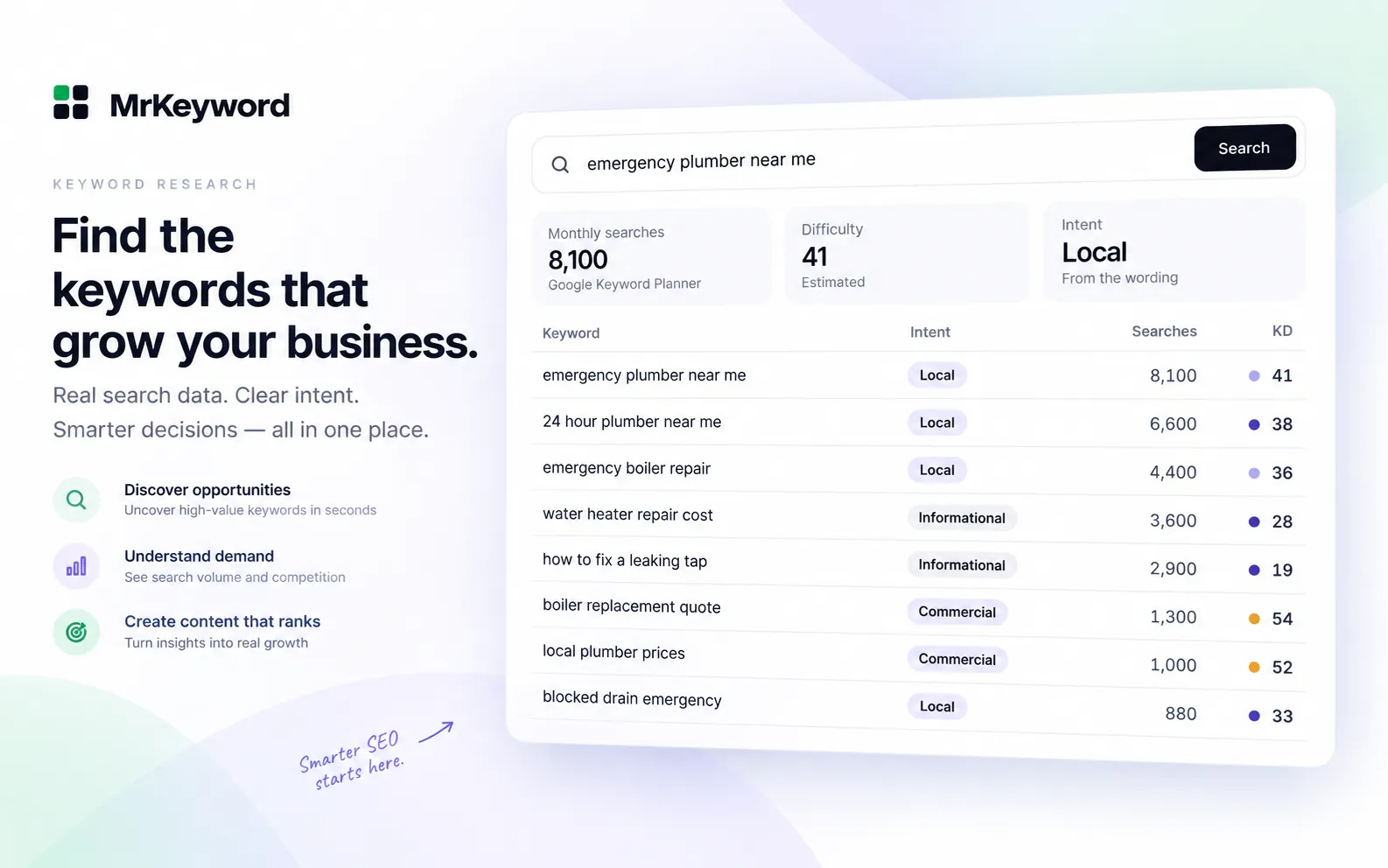
MrKeyword is the low-cost option built on Google's own figures: it requests Keyword Planner data through the official Google Ads API, so you see Google's monthly search volume without a Google Ads account, and it uses no clickstream panel. It is the tool we make, so weigh this section with that in mind.
- Volume. Google's Keyword Planner figure for 15 countries, including the United States, the United Kingdom, Canada, Australia and India, or worldwide, with a monthly trend. Where Google gives only a range, you see the range, labelled as an estimate; we do not invent a midpoint.
- Difficulty. MrKeyword's own estimate. It starts from the keyword data (demand, Google Ads competition, bid and keyword length) and, where MrKeyword's page index, built from its own crawler and public web crawl data, holds enough pages that target the phrase, blends in how strong those sites are in MrKeyword's web graph. It is labelled an estimate because it is not measured from Google's results: MrKeyword never scrapes Google.
- Labels on every figure. Volume, difficulty and intent each carry Measured, Derived, Estimated or Not available, with a confidence level and a one-line reason.
- Your own demand beside it. Connect Search Console and the app shows the queries your site already appears for, with impressions and position, next to the research.
- Lookups and price. One lookup is one keyword in one market; a bulk check takes up to 500 keywords at one lookup per 25. Free includes 10 lookups a month with no card. Starter is $10 a month for 200, Growth $19 for 600 and Agency $49 for 2,000. See pricing.
The full tool is described on the keyword research feature page. The same lookups work from Claude and other assistants through the MCP server, shown in our guide to keyword research with Claude, and developers can use the Data API, with paid plans from $29 a month.
Check a keyword with Google's own figureMrKeyword's free keyword research tool reads Keyword Planner through the official API and shows the source and time on every number.
Try it freeWhy do keyword tools show different search volumes?
Keyword tools disagree because they start from different sources and treat them differently: Google merges close variants and rounds, while modelled tools split variants and fill gaps with clickstream panels. A keyword can read 1,000 in one tool and 1,600 in another without either being broken.
Three habits keep this from misleading you. Compare keywords inside one tool, because relative size holds up far better across tools than any single number. Check the monthly trend, since a 12-month average hides seasonality; Google Trends shows timing on a 0 to 100 scale. And once a page ranks, trust Search Console impressions over any estimate. Difficulty scores need the same care: each vendor builds its own, so a 40 in one tool and a 40 in another do not mean the same thing.
How do you choose a keyword research tool?
Choose by the question you need answered, then by the data source you trust, then by price. These steps get most people to the right tool.
-
Write down the question
“How often is this searched?” needs a volume source. “Which keywords does a competitor rank for?” needs a suite with a competitor database, such as Semrush or Ahrefs. “What do people ask about this?” suits AnswerThePublic.
-
Decide whose numbers you want
If you want Google's own estimate, use Keyword Planner or a tool that reads it through the API. If you want variants split apart and are happy with a model, Semrush or Ahrefs.
-
Count your real usage
A small site may check a few hundred keywords a month. Compare that with each tool's free allowance and lookups before paying for a suite you will half use.
-
Test on keywords you already rank for
Run five keywords from your Search Console through each trial and compare the volumes with your impressions. The tool that tracks your measured demand most closely is the one to trust for new topics.
-
Turn the results into a plan
Map each keeper to one page in a master keyword list, and run a keyword audit on what you already rank for so two pages do not compete for the same term.
If you are weighing whole suites rather than keyword tools, our list of the best SEO tools compares them by job.
What does MrKeyword not do?
MrKeyword does not have a measured or clickstream-based competitor ranking database like Semrush's or Ahrefs'. It shows the keywords any domain is predicted to rank for, labelled Predicted and built from MrKeyword's page index (its own crawler and public web crawl data), and it cannot make Google's figures more exact than Google publishes them.
- It does not use clickstream data, so it does not split close variants that Google merges.
- It does not give exact search counts: Keyword Planner figures are rounded estimates or ranges, and that is what you see.
- It does not scrape Google, so its difficulty is an estimate, not a reading of the live results page.
- It is not a Google product and is not affiliated with Google.
- The Free plan includes 10 lookups a month; regular research needs a paid plan.
Questions and answers
Best keyword research tools questions
What is the best keyword research tool?
It depends on the job. Google Keyword Planner gives Google's own figures, Semrush and Ahrefs have the deepest databases and competitor data inside full suites, KWFinder and Ubersuggest are cheaper and simpler, AnswerThePublic finds questions, and MrKeyword shows Keyword Planner figures without a Google Ads account.
Which keyword research tool has the most accurate search volume?
No tool publishes exact counts. Keyword Planner is Google's own estimate but is rounded and merges close variants; Semrush and Ahrefs model volume from several sources, clickstream included. The most reliable check is your own Search Console impressions for queries where you already rank near the top.
What is the best free keyword research tool?
Google Keyword Planner is free with a Google Ads account. Semrush's Free plan includes 10 reports a day, KWFinder 5 lookups per 24 hours, and MrKeyword 10 Keyword Planner lookups a month with no card. Google Search Console is free for queries your own site already appears for.
Why do Semrush and Ahrefs show different volumes from Keyword Planner?
They model volume from several sources. Semrush combines third-party data with clickstream data, and Ahrefs blends Keyword Planner, Google Trends and other sources. Google merges close variants into one rounded figure, while these models split them, so the numbers rarely match.
Does MrKeyword use clickstream data?
No. MrKeyword requests search volume from Google Ads Keyword Planner through the official API and labels every figure with its source. Its difficulty score is its own estimate from keyword data and its own page index. It never scrapes Google.
Sources
- Keyword Planner — Google Ads, Keyword Planner as a free resource
- Use Keyword Planner — Google Ads Help, on billing information needed for basic features
- About Keyword Planner forecasts — Google Ads Help, on rounding, 12-month averages and close variants
- Google Keyword Planner throttled for low spenders — Search Engine Roundtable, 15 August 2016, on the limited data view
- FAQ about Google Trends data — Google Trends Help, on 0 to 100 scaling
- About Search Console — Search Console Help: a free service offered by Google
- Semrush pricing — Free plan and SEO plan, checked 31 October 2026
- What is Search Volume in Semrush? — Semrush Knowledge Base, on third-party and clickstream data
- Ahrefs pricing — checked 31 October 2026
- How accurate is keyword search volume in Ahrefs? — Ahrefs Help, on sources and estimation
- Traffic potential and Search volume in Keywords Explorer — Ahrefs Help, on clickstream and 12-month averages
- Ahrefs Keyword Generator — free page, no limits stated; checked 31 October 2026
- Moz Pro pricing — plans and keyword queries, checked 29 October 2026
- Moz Keyword Explorer — keyword index size, checked 29 October 2026
- Mangools KWFinder — free lookups, checked 31 October 2026
- Top 5 questions about KWFinder — Mangools, on its search volume data
- Mangools plans and pricing — plan names without amounts, checked 31 October 2026
- Ubersuggest pricing — price range, report limits and trial, checked 31 October 2026
- Ubersuggest keyword ideas: what the data tells you — Neil Patel, May 2026, on Ubersuggest and AnswerThePublic data sources
- AnswerThePublic pricing — checked 31 October 2026
- MrKeyword pricing — our own plans and lookup allowances