Critical
The six that break pages outright.
- Server errors (5xx)
- Broken pages (4xx)
- Broken internal links
- Redirect loops
- Missing title tag
- Forms that submit over HTTP

This SEO audit tool runs MrKeyword's own crawler over your site, applies 60 technical checks, and sorts what it finds by how many pages each problem affects — so the first thing on the list is the first thing worth doing. A full technical SEO audit, with the fix written out for every issue.
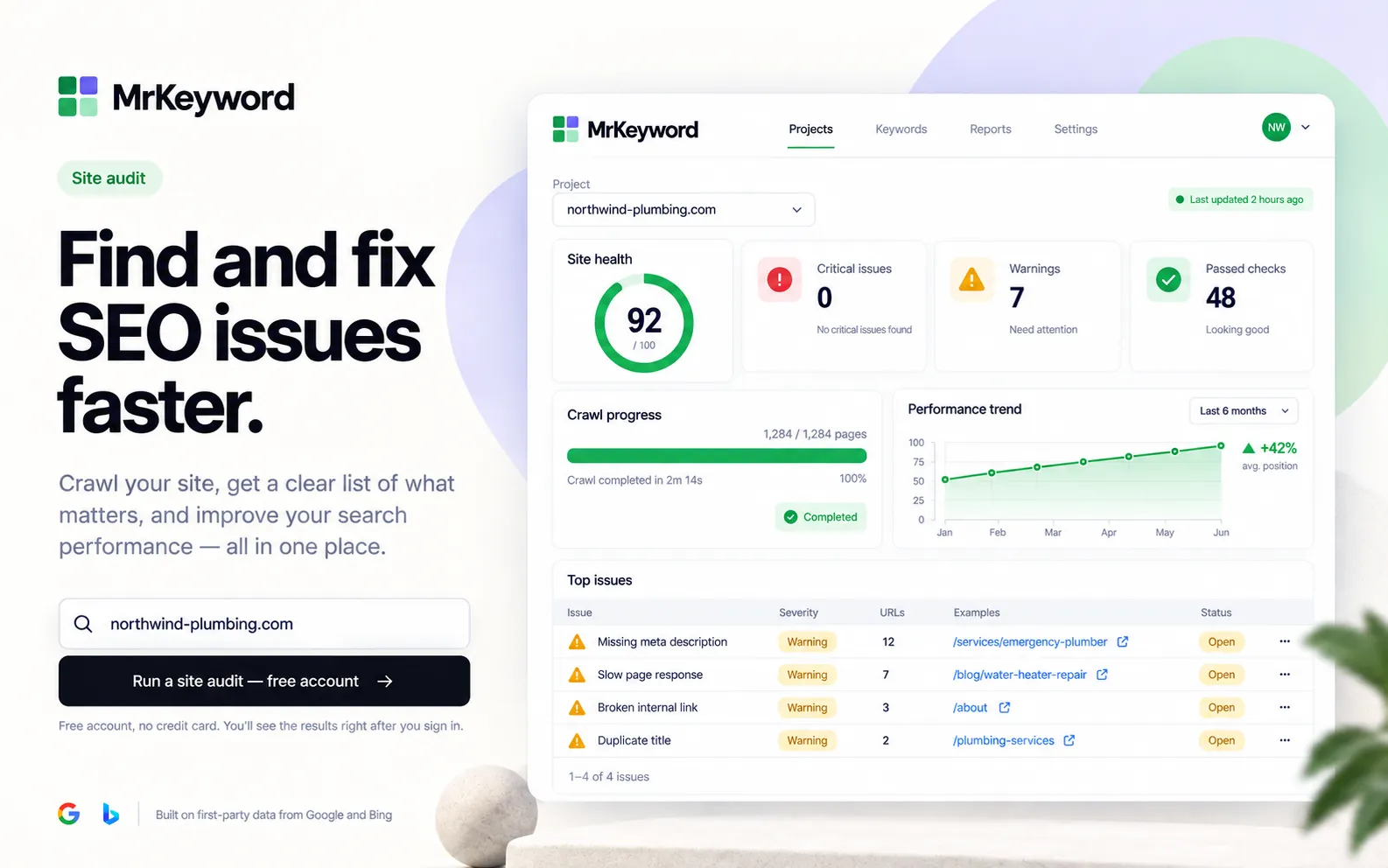
The sample site scores 82 out of 100 across 1,247 crawled pages, with the issues grouped by category so the widest problem is at the top. The score is 100 − Σ weight × √(share of pages affected), weighted 25 for a critical issue, 8 for a warning and 2 for a notice — and the product shows you that sum rather than hiding it.
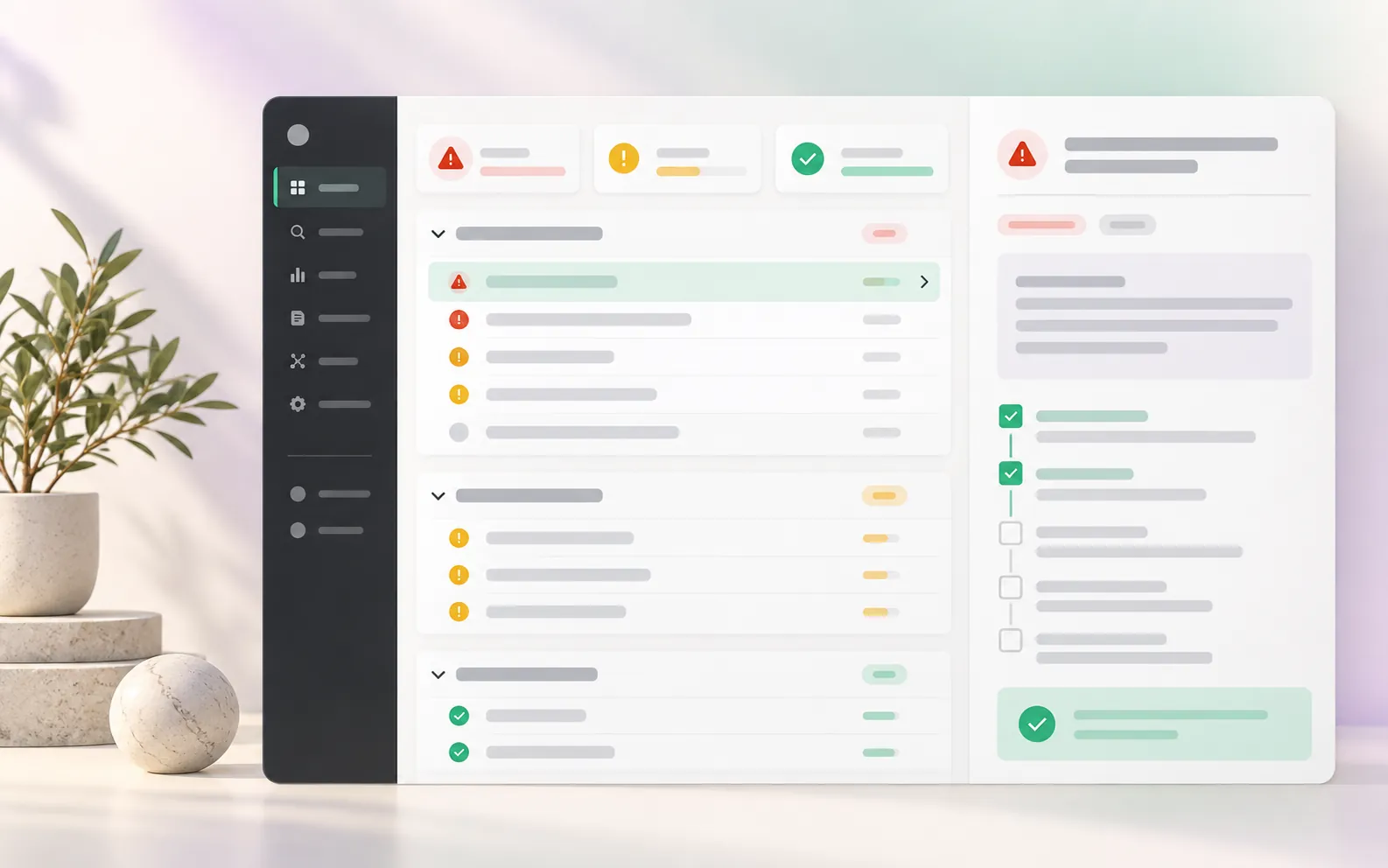
Programmatic pages fail in groups, not one at a time. MrKeyword folds crawled URLs into templates and reports each one's page count, the share that is thin, and how alike the pages are — so you can fix the template instead of 400 URLs. The Issues tab groups the rest by category, so the widest problem is at the top of the list rather than whichever check happened to run first.
What did the last audit of this page find, and what do I fix first?
Tools usedget_latest_page_auditget_daily_issues
The audit keeps technical issues and user experience signals together, with field data named when it exists and a clear needs-data state when it does not. That makes the next fix easier to prioritize than a generic speed score.

A single audit tells you what is wrong today. Crawl-over-crawl history shows what is new, fixed and still present, so the audit becomes an operating record instead of a one-off checklist.

6 critical, 24 warnings and 30 notices — a full technical SEO audit of the site, with a plain-English explanation of the fix on every one.
The six that break pages outright.
Twenty-four issues that quietly hold rankings back.
Thirty-one smaller things worth cleaning up.
A health score out of 100 with its band, counts of critical, warning and notice issues, a crawl-over-crawl diff of what is new, fixed and persisting, and the biggest score deductions.
Grouped by type, filterable by severity and by whether an issue is new, persisting or fixed since the last crawl, each with its fix and the pages affected.
Fifteen filters — indexable, noindex, canonicalised, 4xx, 5xx, redirects, blocked by robots.txt, orphan pages, in sitemap, slow responses and more — with status, indexability, click depth, inlinks, word count and response time.
LCP, INP and CLS for mobile and desktop from Google's PageSpeed Insights, with the source named: Chrome UX Report field data, or a lab test where Google has no field data yet.
Fetch any single page on demand for a full rule check: a page score, category meters, ranked recommendations with an effort tag, structured data found and suggested JSON-LD drafts. It does not use your crawl allowance.
Weekly, every 30 days, or off. Owners and admins set the schedule, and the next run time is shown.
Each Core Web Vitals panel names whether the numbers are Chrome UX Report field data for that exact URL, field data for the whole origin, or a lab run — because those three are not the same evidence.
The crawl runs from MrKeyword's own infrastructure, politely, and identifies itself so you stay in control.
Parsed to RFC 9309, with Crawl-delay honoured up to 10 seconds. MrKeyword never ignores robots.txt to reach a page, and it only crawls sites in your own workspace.
Per site, with a 15-second request timeout. HTML is capped at 5 MB, sitemaps at 20 MB, up to 50 sitemap files and 50,000 sitemap URLs.
The www. and apex forms are treated as one site, nofollow links are not followed, and tracking parameters are stripped before a URL is queued.
The crawler identifies itself as MrKeywordBot/1.0, so you can see it in your logs and control it from your own robots.txt.
Good means LCP ≤ 2.5 s, INP ≤ 200 ms and CLS ≤ 0.1. A lab test cannot measure INP, so where Google has no field data the panel reads “Needs field data” instead of printing an estimate.
Being clear about the edges is part of the product. These are deliberate limits, not gaps we are hoping you will miss.
Connect a property and this page becomes your numbers. Free to start.